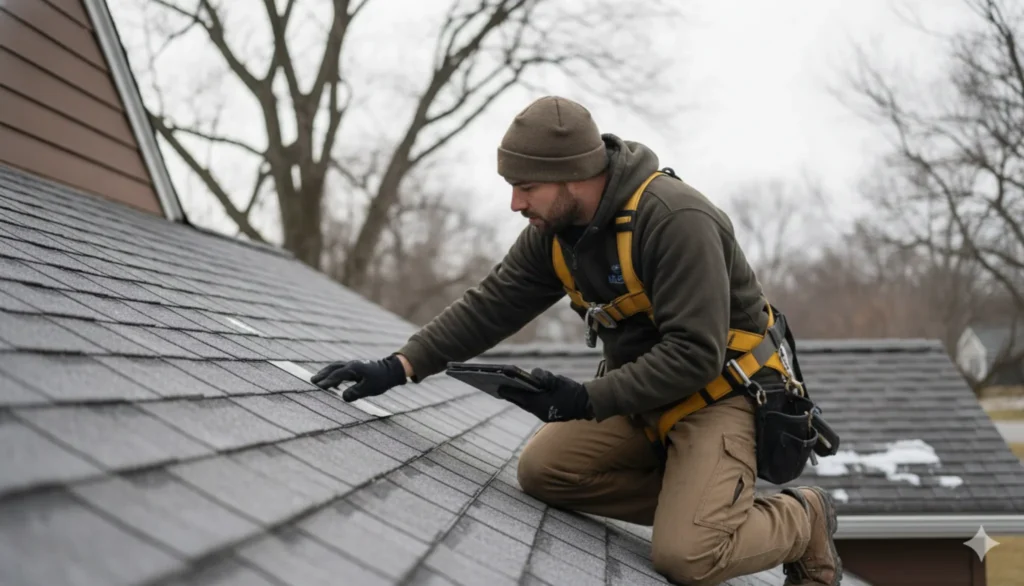
The honest answer to “how long does a roof last?” is: it depends. It depends on the material, the installation quality, how well it’s been maintained, and—critically for anyone in the Capital Region—the climate it must withstand. Over nearly three decades of roofing in Albany and the surrounding area, our crews have consistently seen roofs fall at the lower end of their nationally rated ranges. Albany’s winters are genuinely hard on every roofing material. The same shingles that might last 28 years in a moderate climate frequently need replacement at 20–22 years here. Understanding why, and what to expect from each material type in this specific climate, puts you in a much stronger position to plan, budget, and act at the right time.
Quick Answer: In Albany, NY, asphalt shingle roofs typically last 12–28 years depending on type, with Albany’s freeze-thaw cycles and 60+ inches of annual snowfall shortening lifespans compared to national averages. According to the International Association of Certified Home Inspectors (NACHI), the national average for architectural shingles is 30 years—but in the Capital Region, 20–25 years is a more realistic expectation. Metal roofs last 40–70 years. Natural slate lasts 75–150+ years.
Why Albany’s Climate Shortens Roof Lifespans
Before getting into specific materials, it’s worth understanding what Albany’s weather actually does to a roof over time—because the national lifespan averages you’ll find in most guides are based on moderate climates, not Upstate New York winters.
The Freeze-Thaw Problem
Albany experiences 30–50 freeze-thaw cycles every year, according to NOAA climate data for the Capital Region. Every time moisture in shingles, flashing, or underlayment freezes, it expands. Every time it thaws, it contracts. That repeated expansion and contraction—happening dozens of times in a single winter—is one of the most destructive forces any roofing material faces. It works sealants loose, cracks brittle materials, and gradually opens pathways for water infiltration that weren’t there when the roof was new.
Albany County’s 90-Pound Snow Load Standard
Albany County enforces a 90-lb snow load standard for roofing systems—one of the more demanding building code requirements in the Northeast. That standard reflects a real and recurring stress: Albany averages more than 60 inches of annual snowfall, with some winters significantly exceeding that figure. The weight load on a roof during and after major accumulation events tests every component in the system, not just the shingles.
Ice dams are the related problem that causes the most interior damage. When heat escapes from the living space through a poorly insulated or ventilated attic, it melts snow on the upper roof. That meltwater flows down to the eaves, refreezes, and creates a dam. Water backs up behind it and works beneath shingles, bypassing the roof system entirely. Ice dams don’t just cause immediate leaks—the freeze-thaw cycling they create at the eave edge accelerates shingle deterioration in exactly the area most exposed to stress.
Summer Heat and UV
Albany summers bring genuine heat—temperatures regularly reaching the upper 80s and occasionally the 90s, with meaningful humidity. Summer UV exposure degrades asphalt binders, dries out wood shingles, and bleaches and weakens surface materials over time. The combination of cold-weather stress and summer UV is a more demanding annual cycle than most roofing materials face in milder climates.
How Long Does a Roof Last in Albany? Quick Reference by Material
| Material | National Average Lifespan | Albany/Upstate NY Lifespan | Key Albany Factor |
| 3-tab asphalt shingles | 15–20 years | 12–18 years | Freeze-thaw cycling, UV degradation |
| Architectural asphalt shingles | 25–30 years | 20–28 years | Ice dam stress, granule loss |
| Impact-resistant asphalt shingles | 30–40 years | 25–35 years | Better freeze-thaw performance |
| Metal (standing seam) | 40–70 years | 40–70 years | Excellent cold-climate performance |
| Metal (exposed fastener) | 25–40 years | 20–35 years | Fastener sealant degrades in freeze-thaw |
| Cedar shake / wood shingles | 20–30 years | 15–22 years | Moisture retention accelerates decay |
| Synthetic slate / composite | 30–50 years | 28–45 years | Strong cold-climate option |
| Natural slate | 75–150+ years | 75–150+ years | Performs excellently in cold climates |
| EPDM flat roofing | 15–25 years | 12–20 years | UV and temperature cycling |
| TPO flat roofing | 15–25 years | 15–22 years | Good cold-climate flexibility |
How Long Does an Asphalt Shingle Roof Last in Albany?
Asphalt shingles are on the majority of Capital Region homes. Understanding exactly what to expect from them in this climate is the single most useful thing most Albany homeowners can know.
3-Tab Asphalt Shingles: 12–18 Years in Albany
Three-tab shingles—the flat, single-layer shingles installed on many homes built before the 1990s—are the most vulnerable to Albany’s climate. They’re thinner, lighter, and have less granule coverage than architectural shingles. In our climate, where wind, freeze-thaw cycles, and ice dam events are recurring annual stresses, 3-tab shingles frequently reach the end of their useful life at the lower end of their rated range.
According to NACHI, the national average for 3-tab shingles is 20 years—but in the Capital Region, 15 years is a more accurate planning figure, and 18 years represents a well-maintained roof that has performed well. If your home has 3-tab shingles approaching 15 years old, an inspection is a reasonable priority—not because something has necessarily failed, but because you want to know where you stand before the roof tells you in the form of a ceiling stain.
Architectural (Dimensional) Shingles: 20–28 Years in Albany
Architectural shingles—the thicker, layered shingles that form the majority of replacements installed in the last 20 years—perform meaningfully better than 3-tab in Albany’s climate. The extra thickness, higher granule density, and improved sealant strips give them more resistance to freeze-thaw cycling and wind uplift.
In Albany, a well-installed architectural shingle roof with good attic ventilation and consistent maintenance realistically delivers 22–26 years of reliable service. The upper end of the range requires favorable conditions: a well-ventilated attic, minimal tree canopy, and a well-pitched roof that sheds snow efficiently. NACHI’s national average of 30 years is achievable in moderate climates—but not something Capital Region homeowners should plan around.
Impact-Resistant Shingles: 25–35 Years in Albany
Impact-resistant shingles—Class 4 rated for hail and impact resistance—aren’t just for hail-prone markets. Their more flexible, impact-absorbing construction also performs better through freeze-thaw cycling. For homeowners replacing their roof and planning long-term ownership, the upgrade cost is often justified by both the performance gain and potential insurance premium reduction.
How Long Does a Metal Roof Last in Upstate New York?
Metal roofing is one of the best choices for Albany’s climate. The reasons come down to how metal handles the specific stresses the Capital Region delivers every year.
Standing Seam Metal: 40–70 Years in Albany
Standing seam metal roofs—where the metal panels interlock at raised seams with no exposed fasteners—perform exceptionally well in cold climates. Metal doesn’t absorb moisture, so freeze-thaw cycling doesn’t affect it the same way it affects asphalt. Metal sheds snow cleanly rather than holding it, reducing ice dam risk significantly. And metal expands and contracts as a continuous system rather than cracking or separating at individual points.
In Albany, a properly installed standing seam metal roof is a legitimate 40-to-70-year investment—one that will likely outlast the homeowner who installs it. The higher upfront cost relative to asphalt is real, but the cost-per-year calculation often favors metal significantly over a 40-year horizon.
Exposed Fastener Metal Panels: 20–35 Years in Albany
Exposed fastener metal panels—where screws penetrate the panel surface—are less suited to Albany’s freeze-thaw climate than standing seam. The rubber washers that seal each fastener penetration degrade over time, and freeze-thaw cycling accelerates that degradation. For primary residential roofing in Albany, standing seam is the stronger choice. Exposed fastener panels are a reasonable option for outbuildings and commercial applications with planned maintenance schedules.
Natural Slate: The Long-Duration Choice for Capital Region Homes
Albany and the surrounding area have a significant inventory of historic homes built in the late 19th and early 20th centuries—and a substantial portion were originally roofed with natural slate. There’s a reason for that, and it’s still valid today.
Natural Slate: 75–150+ Years in Albany
Slate is impervious to the freeze-thaw cycle that shortens the life of every other material on this list. It doesn’t absorb moisture, doesn’t crack under cold, and doesn’t degrade from UV exposure. A properly installed slate roof in Albany can reasonably be expected to outlast the home’s other structural components.
The practical considerations are real: slate is heavy (requiring structural assessment before installation), expensive, and requires skilled installation and periodic flashing maintenance to deliver its full lifespan. But for homeowners with historic properties or genuine long-term ownership plans, natural slate is the closest thing to a permanent roofing solution available.
Synthetic Slate: A Practical Middle Ground
For homeowners drawn to slate’s durability but constrained by budget or structural considerations, high-quality synthetic slate—polymer composite products—offers 28–45 years of reliable service in Albany’s climate, handles freeze-thaw cycling well, and carries the aesthetic of natural slate at substantially lower weight and cost.
Cedar and Wood Shingles: Why Albany’s Climate Is Hard on Them
Wood shingles and cedar shakes are beautiful—and genuinely challenging in Albany’s climate. The combination of prolonged winter moisture, spring and summer humidity, and repeated freeze-thaw cycles creates ideal conditions for wood degradation: rot, splitting, and moss and lichen growth that accelerates both.
Cedar Shake: 15–22 Years in Albany
In drier climates, cedar shake roofs can achieve 25–30 years. In Albany’s humid, snowy, wet climate, the realistic lifespan is 15–22 years—and requires consistent maintenance (cleaning, sealing, moss treatment) to reach the upper end of that range.
Homeowners with cedar roofs in the Capital Region should plan for replacement at or before 20 years regardless of cosmetic appearance. The wood can look acceptable from the ground while the substrate beneath it is in significantly worse condition.
Flat Roofing in Albany: What Commercial and Residential Owners Should Know
Flat or low-slope roofing is common on commercial buildings, additions, and some residential designs throughout the Capital Region.
EPDM: 12–20 Years in Albany
EPDM rubber membrane handles cold temperatures and snow loads well—better than many alternatives—but UV exposure and thermal cycling gradually degrade the membrane, particularly at seams and penetrations. In Albany, a well-installed EPDM roof with properly adhered seams and regular inspection delivers 12–20 years of reliable service.
TPO: 15–22 Years in Albany
TPO is increasingly common for commercial applications in the Capital Region. Heat-welded seams create a more reliable bond than adhesive-applied EPDM seams—a meaningful advantage in a climate where thermal cycling stresses seam adhesion continuously. For commercial roofing in Albany, TPO is a strong performer.
How Do I Know When My Roof Needs to Be Replaced in Albany?
Knowing your material’s lifespan is the starting point. Here’s what to watch for as your roof approaches the later years of its expected range.
Warning Signs That Warrant a Professional Inspection
From the ground:
- Dark streaking, moss, or visible algae growth concentrated on one slope
- Visible shingle curling, lifting, or cupping at edges
- Missing shingles in any area
- Sagging or uneven roofline
- Granule buildup in gutters or at downspout discharge
From the attic:
- Daylight visible through the roof deck
- Water staining on rafters or decking
- Frost or moisture on the underside of the deck in winter
- Compressed or wet insulation near the eaves
Inside the home:
- Ceiling staining that appears or worsens after precipitation
- Paint bubbling or peeling near ceilings in upper-floor rooms
- Musty smell in attic spaces
Any one of these can have an explanation short of full roof failure. But any one of them also warrants professional eyes on the roof—finding out early is almost always better than finding out after damage has compounded.
The Albany Homeowner’s Roof Inspection Timeline
| Roof Age | Recommended Action |
| Under 15 years | Annual visual checks from the ground after significant weather events |
| 15–20 years (3-tab) or 18–22 years (architectural) | Schedule a professional inspection; understand where you stand |
| Approaching upper end of Albany range | Budget for replacement within 1–3 years; don’t wait for a failure event |
| After any significant weather event | Inspection regardless of age—hail, wind over 50 mph, heavy ice |
How to Budget for a Roof Replacement Before You Need One
This is the section most homeowners skip—and then feel blindsided by. A roof replacement in the Capital Region is a significant expense. Understanding it as a planned, budgetable event rather than an emergency is one of the most useful shifts a homeowner can make.
What Roof Replacement Costs in Albany
For a standard architectural shingle replacement on a typical Albany-area home (1,500–2,500 square feet of roof surface), expect current pricing in the range of $8,000–$18,000 depending on pitch, complexity, material grade, and contractor. Metal roofing typically runs $18,000–$35,000 for standing seam on a similar home. Slate ranges significantly based on scope and whether the structure requires reinforcement.
The “Roof Fund” Approach
If your roof is approaching the midpoint of its expected lifespan, consider setting aside a designated monthly amount for eventual replacement. For a roof that might cost $12,000 to replace in 8 years, that’s approximately $125 per month—a manageable planning figure that makes the eventual project a financial non-event rather than a crisis. That kind of foresight is exactly what separates homeowners who handle this transition smoothly from those who feel forced into rushed decisions.
Your Roof’s Clock Is Already Running
Every roof in the Capital Region is on a clock. The question isn’t whether it will eventually need replacement—it’s whether you’ll know in time to plan for it thoughtfully, or whether a failure event will make the decision for you.
The homeowners who handle this best aren’t the ones who got lucky with long-lasting roofs. They’re the ones who knew what material they had, understood roughly where it was in its lifespan, watched for the early warning signs, and had a professional take a look before a minor issue became an expensive one.
That’s not luck. That’s just paying attention—and the payoff is real.
About Star Roofing
Star Roofing was founded in 1997 by the Wall and Fedele families and has been a trusted name in the Capital Region ever since. As a second-generation, family-owned company, Star is built on three straightforward principles: do the job right, treat people with respect, and stand behind every roof installed. Their highly trained crews serve residential and commercial customers throughout the Albany area with honest assessments, quality materials, and the kind of care that comes from knowing your neighbors are your customers. Reach out today—we’d love to help you move forward with confidence.