Quick Answer
Yes—skylights can work well in cold climates, but they do lose more heat than vertical windows: about 1.6 times as much in winter, according to building science testing. That’s not a reason to skip them. It’s a reason to choose a unit rated for your climate zone (U-factor 0.55 or lower) and have it installed with proper flashing, insulation, and curb height for snow country.
With years of hands-on experience installing and repairing roofs across the Capital Region’s snow, ice, and freeze-thaw cycles, we get this question a lot from homeowners who love the idea of a skylight but worry it’ll turn into a cold spot—or worse, a leak—come January. Here’s the honest breakdown of what skylights actually cost you in heat, how much of that you can control, and what separates a skylight that lasts through Capital Region winters from one that doesn’t.
What Makes a Cold-Climate Skylight Different
A skylight installed in a Capital Region winter deals with things a skylight in Charlotte or Phoenix never has to: sustained sub-freezing temperatures, repeated freeze-thaw cycling, and snow load sitting directly on the glazing for weeks at a time. That’s why “any skylight” and “the right skylight” are two very different purchases up here, whether you’re adding one during a new roof installation or retrofitting an older home.
The two specs that matter most are U-factor and Solar Heat Gain Coefficient (SHGC), both rated by the National Fenestration Rating Council (NFRC). U-factor measures how much non-solar heat escapes through the unit—lower is better in winter. For heating-dominated northern climates like ours, the recommended threshold is a U-factor of 0.55 or lower for skylights, compared to 0.30 or lower for vertical windows (NACHI, U-Factor Ratings for Windows).
Are Skylights a Good Idea in Cold Climates?
Generally, yes—with the right product and the right installation. Skylights bring in natural daylight that can meaningfully cut down on artificial lighting use, and a well-rated, well-installed unit performs reliably through a New York winter. The catch is that “skylight” covers a wide range of quality, and a cheap, poorly rated, or poorly flashed one is genuinely one of the more common sources of winter roof leaks and ice dam problems we see on inspections.
The honest way to think about it: a skylight is a deliberate hole in your building envelope. That’s not a knock against them—it’s just why the specification and installation quality matter more here than almost anywhere else on the roof. Get both right, and a skylight is a good, durable addition to your Capital Region home. Get either wrong, and it becomes the weak point in the whole roof.
How Much Heat Do Skylights Really Lose in Winter?
This is the part most articles on this topic skip entirely, so let’s put real numbers to it. Building science testing comparing skylights to vertical windows in similar climates found that in a Michigan-type winter climate, windows lost about 20.2 BTU per hour per square foot, while skylights in the same conditions lost about 32.4 BTU per hour per square foot—roughly 1.6 times more heat loss (Energy Vanguard). The angle skylights sit at, combined with their direct exposure to open sky, is the main reason: a vertical window loses heat to the relatively “warmer” ground and surrounding buildings, while a skylight faces the coldest part of the sky all night long. That gap is exactly why the U-factor rating matters more on a skylight purchase than almost anywhere else in the house.
Are Skylights Energy Efficient in Winter?
They can be, if you shop by the numbers instead of the marketing copy. ENERGY STAR-certified windows, doors, and skylights reduce heating and cooling costs by an average of up to 13% nationwide compared to non-certified products, and current ENERGY STAR criteria require skylights to meet U-factor and SHGC thresholds specific to your climate zone rather than a single national standard (ENERGY STAR, Residential Windows, Doors & Skylights). Separately, the U.S. Department of Energy notes that low-E storm windows and glazing upgrades can cut heating and cooling costs by 12% to 33%, depending on what’s being replaced (Department of Energy, Windows, Doors, and Skylights).
Double-pane, argon-filled, low-E skylights are the realistic minimum for a Capital Region installation. Triple-pane units cost more upfront but push the U-factor meaningfully lower and help with a second cold-climate problem: interior condensation forming on the glass on the coldest mornings, which, left unchecked, can drip onto drywall and trim—one more reason regular roof upkeep is worth keeping on the calendar once a skylight is installed.
Can You Install a Skylight in a Snowy Climate?
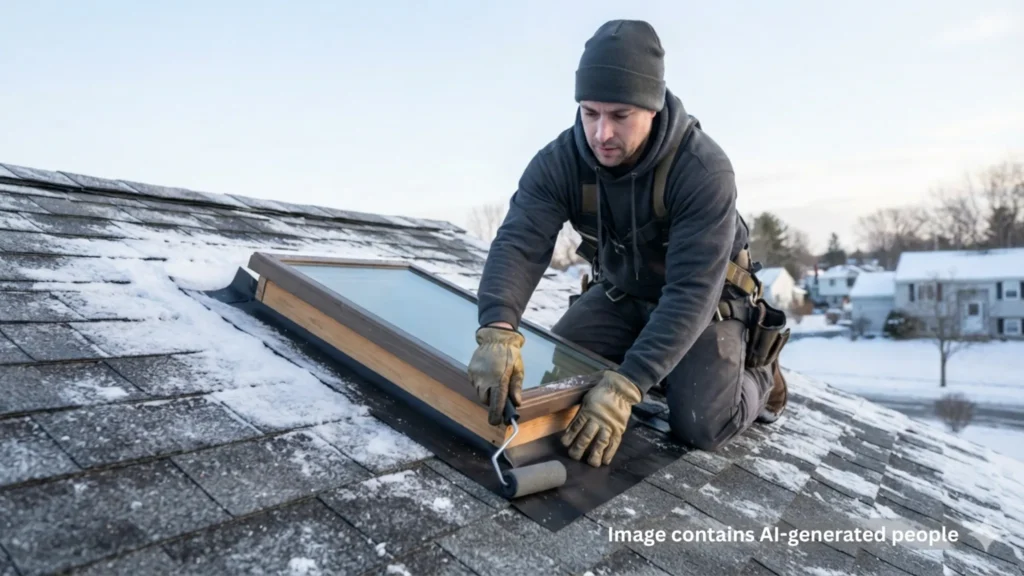
Yes, and it’s a routine job for a roofing contractor who does it regularly—but a few details matter more here than in a milder climate. The curb—the raised frame the skylight sits on—needs to be tall enough to stay above your typical snow accumulation, not just clear of a light dusting. And a properly installed skylight uses a full flashing kit (not just caulk) along with ice-and-water shield underlayment extending well beyond the curb—this is the single biggest factor in whether a skylight leaks during freeze-thaw season.
Ice dams form when heat escaping from the house melts snow on the roof, which refreezes at the colder eaves and edges—and a poorly sealed skylight curb is exactly the kind of heat-leak point that feeds that cycle. Ice dams can start forming with as little as two inches of snow accumulation once that heat-loss pattern is in place (Building America Solution Center, DOE/PNNL). If you’re adding a skylight to a low-slope or flat commercial section, your roofing contractor should confirm through a thorough assessment that the structure can handle the added snow load.
What NOT to Do When Installing a Skylight in a Cold Climate
A few shortcuts show up again and again on the leak calls we get every winter, so we’d rather flag them here than have you find out the hard way.
- Don’t buy on price alone. A single-pane or older double-pane skylight with a high U-factor might save you money upfront, but it’ll cost you in condensation, drafts, and higher heating bills for as long as it’s installed.
- Don’t skip the ice-and-water shield underlayment. Standard felt underlayment alone isn’t enough protection around a roof penetration in a climate that sees repeated freeze-thaw cycles.
- Don’t install a skylight mid-winter over ice and snow. A rushed cold-weather install makes it much harder to get flashing seated and sealed correctly.
- Don’t ignore condensation on the inside of the glass. Occasional light condensation on cold mornings is normal; frost buildup or dripping most mornings usually points to an aging seal or an under-rated unit.
- Don’t assume a skylight rated for a mild climate will perform the same way here. A unit sold for a warmer market may not meet the U-factor threshold your roof actually needs.
If you’re not sure whether an existing skylight was installed to these standards, a roof inspection before winter is the cheapest way to find out.
Seasonal Considerations for Skylight Installation in the Capital Region
Spring and fall are the best windows for new skylight installation or replacement here—mild enough for sealants and flashing materials to cure and seat properly, without the summer humidity or the hard-freeze risk of a winter install. If a skylight is actively leaking mid-winter, that’s a repair situation to stop the damage now, with a full replacement or upgrade planned for the next mild-weather window rather than attempted in the middle of a snowstorm.
Choosing the Right Skylight and Installer
Fixed skylights are the simplest and most weathertight option, and the safest default for a cold climate since there’s no operable seal to fail. Vented skylights add fresh air but introduce one more seal that needs to be flashed and maintained correctly. Tubular skylights (sun tunnels) work well for smaller spaces like hallways or bathrooms, since their smaller roof penetration means less flashing and less thermal bridging overall—whether it’s being cut into a shingle roof or another roofing material.
Whatever type you choose, the installer matters as much as the product. The FTC’s general guidance on hiring a contractor applies directly here: get a written scope of work, verify licensing and insurance, and ask specifically how they’ll flash and insulate around the curb before they start (FTC Consumer Advice, Hiring a Contractor). A contractor who can answer that question in detail, unprompted, is usually the one who’s done this correctly before.
A Skylight Is Only as Good as Its Weakest Detail
The difference between a skylight that adds light and value to your home for twenty years and one that becomes a recurring leak and a cold spot almost never comes down to the brand on the glass—it comes down to the U-factor rating and the quality of the flashing underneath it. Both are entirely within your control before installation, and both are worth getting right the first time in a climate like ours.
We’ve spent years installing, repairing, and inspecting roofs—skylights included—through everything the Capital Region’s winters can throw at them, and we’re always happy to walk through whether a skylight makes sense for your specific roof before you commit to one.
Reach out to Star Roofing today for a free consultation and find out why so many local homeowners and business owners trust us to stand behind every roof we build. No pressure, no hard sell—just honest answers from people who care about getting it right.