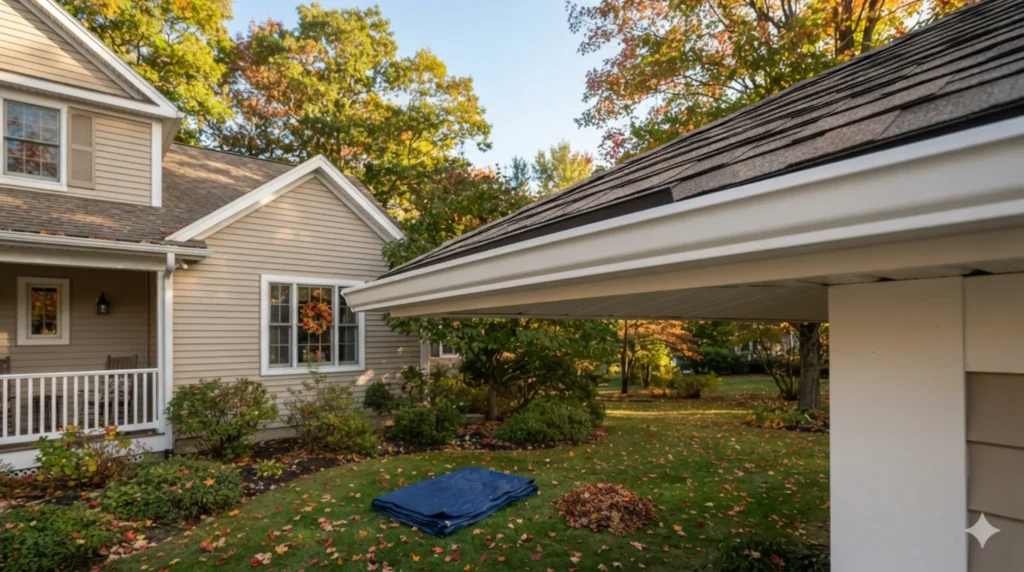
Every fall, we get the same call in early December: “We just noticed our gutters are frozen solid, is that a problem?” It usually is—and by then, the easy window has already closed. Gutter cleaning before leaves fall isn’t just a chore-scheduling question. In the Capital Region, it’s a roof-protection question, and the two aren’t as separate as most homeowners think.
Quick Answer
Gutter cleaning before leaves fall works best when timed after most leaves have dropped but before the first hard freeze—typically mid-to-late October through mid-November here. Clean too early and you’ll redo it in weeks. Clean too late and frozen debris can damage gutters and help ice dams form on your roof.
Why Fall Gutter Timing Is a Roofing Issue, Not Just a Gutter Issue
Here’s the part most cleaning companies won’t tell you, because it’s outside their scope: clogged gutters in winter don’t just mean an overflow problem. They’re one of the leading causes of ice dams—those ridges of ice that build up at a roof’s edge and trap meltwater behind them—and ice dams are a roof problem.
According to the National Roofing Contractors Association (NRCA), ice dams form when heat loss from a home’s interior combines with the insulating effect of snow, warming parts of the roof enough to melt snow above and let it refreeze at the colder overhangs. Once that ice dam forms, the trapped water behind it can back up under shingles and into the underlayment, leading to leaks inside the home. NRCA is also direct about where a lot of this starts: gutters are typically the first place ice dams form, which is exactly why they should be thoroughly cleared of debris before winter arrives.
That’s the whole reason timing matters more than most people assume. A gutter full of wet, decomposing leaves in late November is exactly the kind of starting point an ice dam needs. Clear gutters don’t guarantee you’ll avoid ice dams entirely—attic insulation and ventilation play a role too, which is part of what a thorough residential roofing assessment checks for—but they remove one of the easiest problems to prevent.
If your gutters clog every year no matter when you clean them, it’s also worth asking whether gutter guards make sense for your property. They don’t eliminate maintenance entirely, but they can stretch the time between cleanings and make each one faster—worth weighing against the cost of a second fall visit.
The Right Window for the Capital Region
There’s no single calendar date that works for every yard, because leaf drop and freeze timing both shift year to year. But there’s a reliable sequence to follow.
Step 1: Wait until most leaves are down, not all of them. Cleaning when your maple is half-bare means you’re back on the ladder in three weeks for round two.
Step 2: Clean before the first hard freeze locks debris in place. Once wet leaves freeze solid at the bottom of a gutter, the job changes from a quick scoop to something closer to demolition.
Step 3: For heavy tree cover, plan on two passes. A mid-fall cleaning to clear the early volume (maples, birches), then a second pass once oaks and other late-droppers finish, usually gets Capital Region homes through winter cleanly.
For most homes in Albany, Saratoga, Schenectady, and the surrounding counties, that window lands somewhere in the second half of October into mid-November—but a property with mature oaks overhead might not be ready for its final pass until early November, while a yard with mostly early-dropping trees can often be done and finished by the third week of October. This matters just as much for commercial roofing properties with flat or low-slope systems, where drains and scuppers can clog the same way residential gutters do.
What Happens If You Clean Too Early
This is a real gap in a lot of fall gutter advice: cleaning too early has its own cost. If you clean in late September or the first week of October, in most Capital Region yards you still have weeks of leaf drop ahead. You’ve paid for a cleaning, and by Halloween your gutters are full again—meaning you either pay for a second visit or head into winter with a system that’s clogged anyway. Early cleaning isn’t wasted if you know you’re doing two passes on purpose. It’s wasted when it’s mistaken for a one-and-done job.
What Happens If You Skip It Before Winter
Skipping gutter cleaning before winter doesn’t just mean a messier gutter—it compounds. Here’s what tends to follow, roughly in order of how it shows up:
- Ice dams form more easily and grow larger, because clogged debris gives ice something to anchor to right at the roof edge—consistent with NRCA’s description of gutters as a common starting point for ice damming.
- Water backs up under shingles, which is exactly the mechanism NRCA describes leading to interior leaks, not just gutter overflow.
- Fascia boards absorb repeated moisture, and wood that goes through freeze-thaw cycles wet is wood that eventually rots—a common finding during a roof repair call that started as “just a gutter problem.”
- Weight from trapped ice and saturated debris strains hangers and seams, sometimes enough to pull a gutter run loose from the house entirely.
- Meltwater that has nowhere to go in spring ends up at the foundation, which is a separate, expensive problem that started with a gutter nobody cleaned in October.
None of this happens after one skipped cleaning. It’s the second or third winter of neglect that tends to produce the repair bill—and that bill is the real cost comparison worth making. A typical professional gutter cleaning runs somewhere in the low hundreds of dollars, while fascia repair, ice dam remediation, or a partial roof repair after real water intrusion can run into the thousands. That gap is exactly why a roof maintenance routine that includes gutter timing tends to pay for itself.
Can Clogged Gutters Freeze in Winter?
Yes, and it’s more common than most homeowners expect. Wet leaves and debris hold moisture like a sponge, and once temperatures drop and stay below freezing, that moisture freezes solid inside the gutter. At that point the debris isn’t just sitting there—it’s bonded to the gutter itself, and it stays that way until a sustained thaw. It’s also a good moment to check whether your shingle roofing is holding up at the edges, since that’s where a frozen gutter does the most collateral damage.
What NOT to Do When Gutters Are Already Frozen
If you’ve missed the window and your gutters are already frozen solid, resist the urge to fix it yourself. A few specific mistakes cause more damage than the frozen gutter itself:
- Don’t chip or pry at ice with a screwdriver, hammer, or ice pick. NRCA specifically advises against tools with sharp edges near roof coverings, because they gouge shingles and can puncture gutters that look sturdier than they are.
- Don’t pour hot water on frozen gutters in freezing air temperatures. It often just refreezes lower down and adds weight exactly where the gutter is already stressed.
- Don’t climb an icy ladder without following basic ladder safety. OSHA’s guidance on portable ladder use calls for maintaining three points of contact at all times and inspecting the ladder before every climb—both far harder to do on an ice-coated rung, which is exactly why winter ladder falls are so common.
- Don’t assume it will “just melt out fine” without a plan. Sometimes it does. Sometimes that meltwater has nowhere to go but under your shingles.
If you’re staring at a frozen gutter in January, the honest answer is usually to wait for a sustained thaw or bring in a professional roof inspection to check whether any damage already happened—rather than making it worse trying to fix it in the cold.
Seasonal Note: This Isn’t Just a Fall Task
Fall gets the attention because it’s the obvious debris season, but Capital Region homes benefit from a spring check too—winter is hard on gutter hangers and seams even when they stay clear, and a spring roof inspection after a rough winter often catches loosened hardware before the next storm season tests it.
We Live Here Too, So We Notice These Things Early
At Star Roofing, we’ve walked more Capital Region rooflines than we can count, and the pattern is always the same: the roofs that make it through winter without an ice dam story are almost always the ones with clear gutters going into the cold. That’s not a coincidence, and it’s not complicated—it just requires paying attention to timing instead of waiting until the gutters are visibly full.
We’re a family-owned company, and we take every job personally because we live here too. When you ask us whether your specific yard needs one pass or two this fall, you’re not getting a generic answer pulled from a national playbook—you’re getting an answer based on what actually grows over Capital Region rooftops and how our winters actually behave.
If you’ve noticed debris building up, want a professional inspection before the freeze sets in, or just want an honest read on your timing this year, we’re happy to talk it through. No pressure, no hard sell—just answers from people who care about getting it right, because we take every roof personally.