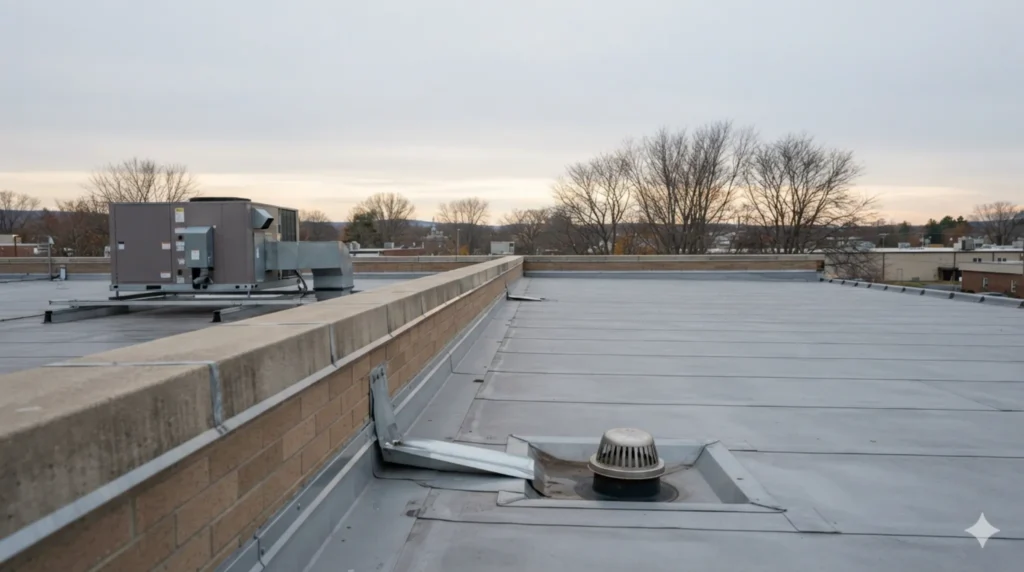
Quick Answer: Flat roof maintenance before snow season means clearing drains, inspecting flashing and seams, checking for ponding, and confirming your roof’s snow load capacity before the first storm. Most commercial flat roofs hold 20–35 pounds of snow per square foot, but wet snow and ice exceed that fast—so a pre-season inspection matters.
If you own or manage a commercial property in the Capital Region, you already know winter isn’t gentle here. We get real snow, real cold snaps, and the kind of freeze-thaw cycling that turns a hairline crack into a full-blown leak over a single season. The roof over your business, your tenants, or your inventory doesn’t get a say in any of that—but you do, if you handle flat roof maintenance before snow season arrives rather than after.
This checklist walks through exactly what to inspect, what to fix, and what to leave to a professional before the snow starts piling up.
Why Flat Roofs Need Extra Attention Before Winter
A pitched residential roof sheds water and snow largely on its own. A commercial flat roof doesn’t have that luxury—by design, it’s meant to hold water briefly while it drains, which means it’s also going to hold snow, at least for a while. That difference is exactly why flat and low-slope commercial roofs see more winter-related failures than sloped residential ones.
Three things make winter uniquely hard on a flat roof:
- Freeze-thaw cycling. Water that gets into small cracks in the membrane or flashing expands when it freezes, widening those cracks. Repeat that cycle a dozen times over a Capital Region winter and a pinhole becomes a real leak.
- Snow load. Snow is heavier than it looks, and it doesn’t fall evenly—drifting around HVAC units, parapet walls, and rooftop equipment can pile far more weight in some spots than others.
- Ice damming and blocked drainage. When drains, scuppers, or gutters are clogged going into winter, meltwater has nowhere to go. It refreezes at the edges, and you end up with standing ice and water sitting directly on the membrane.
None of these are exotic problems. They’re the same handful of issues, year after year—which is exactly why a pre-season checklist works.
The Flat Roof Maintenance Checklist Before Snow Season
1. Schedule a Professional Roof Inspection
Before temperatures start dropping below freezing overnight, get your roof inspected by someone who does this for a living. A trained eye catches loose seams, cracked flashing, and soft spots in the membrane while there’s still time—and still workable weather—to fix them.
A thorough pre-winter inspection should cover:
- Membrane condition, seams, and lap welds
- Flashing and terminations around HVAC units, skylights, and vents
- Roof deck and insulation for signs of trapped moisture or movement
- Drains, scuppers, and overall drainage flow
2. Clear Debris and Confirm Drainage Is Working
Leaves, twigs, and construction debris don’t just look bad—they block the exact pathways your roof relies on to shed water. On a flat roof, a clogged drain in November becomes a frozen puddle in December.
Before the first snow:
- Clear gutters, downspouts, drains, and scuppers completely
- Check behind parapet walls and around rooftop units, where debris likes to collect unnoticed
- Confirm strainers and drain covers are secure and unobstructed
3. Check for Ponding Water
Ponding water that sits for more than 48 hours after a rain is already a sign your drainage or roof slope needs attention—and once winter hits, that same standing water freezes in place. Ice doesn’t drain. It just sits there, adding weight and working its way into any weak point in the membrane below it.
Look for stained or discolored areas, along with any spot where puddles reliably reappear after rain. If you find one, get it evaluated before the accumulation season, not after.
4. Inspect Flashing, Seals, and Penetrations
Flashing around HVAC curbs, vents, skylights, and parapet walls is where most winter leaks actually start. As temperatures swing, materials expand and contract, and sealant that was fine in August can crack by November.
Check for:
- Gaps, lifting, or separation at flashing edges
- Sealant that’s gone brittle, shrunk, or pulled away from the surface
- Penetrations that aren’t fully terminated or watertight
5. Know Your Roof’s Snow Load Capacity
This is the step most checklists skip, and it’s the one that actually answers the question every commercial property owner eventually asks: how much snow is too much?
Most commercial flat roofs in the U.S. are engineered to carry somewhere in the range of 20 to 35 pounds per square foot of snow load, depending on local building codes and when the structure was built—but the honest answer is that the weight of snow matters far more than its depth. According to the Federal Emergency Management Agency’s Snow Load Safety Guide, fresh, fluffy snow can weigh as little as 3 pounds per square foot, while wet, heavy snow weighs closer to 21 pounds per square foot—and ice weighs roughly 57 pounds per square foot. That means two feet of light powder might be nowhere near a concern, while eight inches of wet, heavy snow followed by a freeze could already be pushing a roof toward its limit.
A rough way to check: measure a sample column of snow, melt it, and multiply the resulting water depth in inches by 5.2 to estimate pounds per square foot on your roof. As a general rule of thumb, many roofing professionals recommend having snow removed before accumulation exceeds about a foot in depth—though on a flat roof with drifting around equipment or parapets, some areas can reach that threshold well before others. If you don’t want to do the math yourself, a professional inspection can tell you exactly where you stand, which is a much better time to find out than during a storm.
For properties in consistently heavy-snowfall areas, some commercial owners also install rooftop snow load monitoring sensors that alert building management once accumulation crosses a set weight threshold—worth asking about if your property has a history of drifting or uneven accumulation.
6. Review Your Snow Removal Plan Now, Not During the Storm
Waiting until snow is already piling up to figure out who’s clearing your roof is how small problems become expensive ones. Decide now:
- Who’s responsible. A trained roofing contractor, not building maintenance staff with a shovel, should handle roof-level snow removal.
- How they’ll access the roof safely, including clear walkways and secure ladder or hatch access.
- What equipment is safe to use. The National Roofing Contractors Association recommends that any snow removal attempted from ground level use a roof rake or extended-handle broom only—never ice picks, shovels, or anything with a sharp edge that can damage roof coverings.
7. Protect Rooftop Equipment
HVAC units, exhaust fans, and any electrical or communication equipment on the roof are easy to overlook during a general inspection—but they’re common failure points once snow and ice start drifting around their bases. Confirm condensate drains are clear, flashing at equipment curbs is intact, and weatherproofing on electrical connections is solid before the first hard freeze.
8. Confirm Insulation and Interior Heat Loss Aren’t Working Against You
Ice dams don’t only form because of what’s happening on top of the roof—they’re often caused by heat escaping from inside the building, which melts snow from underneath and lets it refreeze at the colder edges. Confirming adequate insulation and checking for air leaks near the roof deck is a maintenance step that pays off twice: lower heating costs now, and fewer ice dams once temperatures drop.
What NOT to Do Before Snow Season
- Don’t ignore small ponding areas because they “always drain eventually.” Once that water freezes, it stops draining entirely until spring.
- Don’t let untrained staff attempt roof-level snow removal. An icy flat roof is one of the most hazardous work surfaces there is, and improper technique causes more membrane damage than the snow itself.
- Don’t use metal shovels, ice picks, or anything with a sharp edge on the membrane. Even a small puncture becomes a major leak once meltwater finds it.
- Don’t push cleared snow into piles against parapet walls or equipment. That concentrates weight exactly where the structure is least equipped to handle it.
- Don’t skip documentation. Photograph your roof’s condition before the season starts. If you do end up filing an insurance claim after a storm, dated before-and-after photos make the difference between a smooth process and a disputed one.
Seasonal Considerations for the Capital Region
Winters here aren’t a single event—they’re a season of freeze-thaw cycling, occasional heavy wet snow, and stretches of bitter cold that can go on for weeks. That combination is tougher on a commercial roofing system than either extreme alone. A roof that handled a light dry snow just fine in December can be under real stress after a February thaw-and-refreeze cycle dumps meltwater into every crack that opened up over the winter. Building in a mid-winter check—not just a fall inspection—is worth the extra step for properties in this climate, and it’s a habit worth carrying into spring roof maintenance planning as well.
Business Considerations Beyond the Roof Itself
A commercial roof failure isn’t just a maintenance issue—it’s a business interruption issue. A few things worth handling alongside your physical inspection:
- Notify your insurer before winter, not after a claim. Confirm what your policy actually covers for snow load, ice dam, and interior water damage, and keep your pre-season inspection report on file as documentation of due diligence.
- Loop in tenants early if your property has multiple occupants, so everyone knows the snow removal plan and who to contact if they notice a leak.
- Flag any pre-existing damage in writing before the season starts. It protects you if a storm-related claim ever gets compared against prior conditions.
We Take Winter Seriously Because We Live Here Too
At Star Roofing, we’re not looking at your building from a regional office somewhere else—we’re dealing with the same freeze-thaw winters, the same heavy Capital Region snowfalls, and the same bitter February thaws that your roof has to handle. We’ve spent years working on residential and commercial roofs across Albany, Saratoga, Schenectady, and the surrounding counties, and we’ve seen exactly what a skipped pre-season inspection tends to cost a property owner by February.
We’re a family-owned company, still run by the same values it was built on back in 1997: do the job right, treat people with respect, and stand behind every roof we touch. Whether you need a full pre-winter inspection, a second opinion on a ponding area, or just want an honest read on whether your flat roof is ready for the season ahead, we’re happy to come take a look—no pressure, no upsell, just a straight answer from people who understand what this climate does to a roof.
Reach out to Star Roofing today for a free consultation and find out why so many local homeowners and business owners trust us to stand behind every roof we build. No pressure, no hard sell—just honest answers from people who care about getting it right.