Quick Answer
Yes—a properly applied flat roof coating can extend a commercial roof’s life by up to 20 years by sealing out UV rays, water, and thermal stress. It works best on roofs that are still structurally sound, costs a fraction of full replacement, and improves energy efficiency along the way. It’s not a fix for every roof, though.
Flat roof coating gets talked about like a miracle fix, and honestly, it can come pretty close when it’s the right roof for the job. With years of hands-on experience on commercial flat roofs across the Capital Region, we’ve walked plenty of business owners through this decision, and the honest answer is a little more nuanced than “coat it and forget it.” Here’s what a flat roof coating actually does, how long it lasts, and how to know if your building is a good candidate—or not.
What Is Roof Coating and How Does It Work?
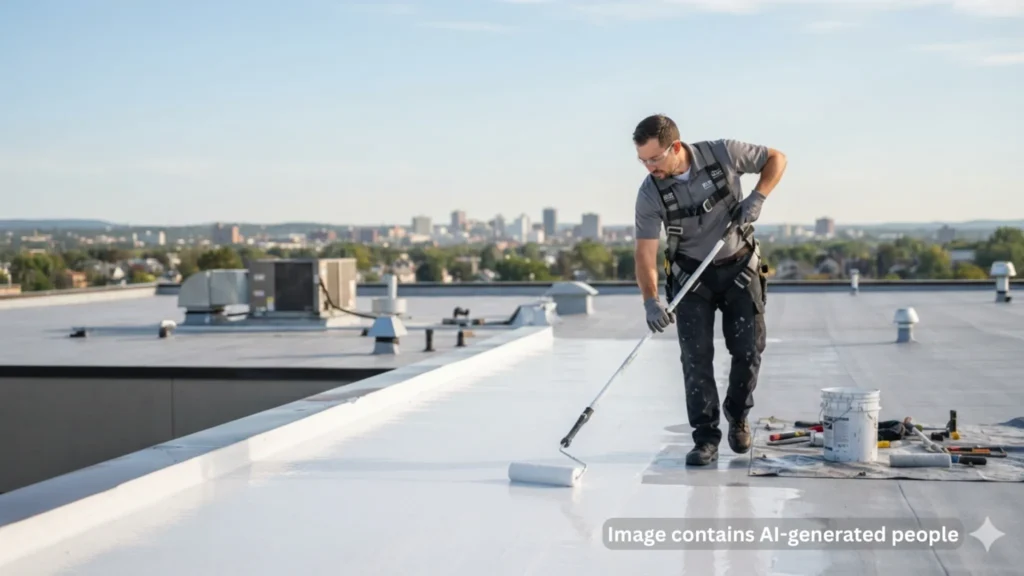
A roof coating is a fluid-applied, monolithic membrane that goes on top of your existing roof—usually with a sprayer, roller, or squeegee—and cures into a seamless, flexible layer. Think of it less like paint and more like a second skin: it bonds to the substrate and stretches and contracts with the building as temperatures shift, without cracking the way rigid coatings do.
Most commercial coatings fall into a few families: silicone (excellent UV resistance and ponding water tolerance), acrylic (budget-friendly, strong reflectivity, best in drier climates), and polyurethane (higher foot-traffic durability). Once cured, the coating seals seams, fastener heads, and surface imperfections into one continuous, waterproof layer over your existing flat roof system—a protective shell, not a patch.
The Real Purpose of a Flat Roof Coating
The purpose of a flat roof coating is simple: it shields your existing roof membrane from the elements that break it down fastest—UV radiation, standing water, and constant thermal expansion and contraction. Flat and low-slope commercial roofs take more direct sun and hold more water than pitched residential roofs ever will, which is exactly why coatings were developed for this category in the first place. A coating isn’t a new roof—it’s a protective layer that buys your existing roof additional years of service before it would otherwise need a full tear-off.
How Long Does Roof Coating Last on a Flat Roof?
According to industry reporting in Construction Specifier, a professionally applied silicone roof coating can extend a commercial roof’s usable lifespan by up to 20 years, with most systems needing a recoat around the 10-year mark to maintain full protection (Construction Specifier, 2026). That recoat isn’t a failure—it’s routine maintenance, similar to repainting a house.
Cost is part of the honest picture too. That same reporting put silicone coating installation at roughly $2 to $4 per square foot, compared to $6 to $8 per square foot for a complete tear-off and replacement—meaning coating typically runs 30% or more below the cost of starting over.
Does Roof Coating Actually Extend the Life of a Roof?
Yes, when it’s applied to a roof that’s still structurally sound. Roof degradation happens through predictable mechanisms: UV rays break down the membrane’s top layer, standing water works into seams over time, and repeated heating-and-cooling cycles fatigue the material. A coating interrupts all three at once.
That matters even more here than in a lot of the country. Our winters put roofs through repeated freeze-thaw cycles—water gets into tiny cracks, freezes, expands, and widens the damage, then does it again the next week. A coating that seals those vulnerable points before winter hits is doing real, measurable work, not just cosmetic touch-up. Regular roof maintenance and timely coating are two of the few things a building owner can actually control here.
One honest caveat: coating extends the life of a roof that still has structural integrity. It doesn’t reverse damage that’s already happened—if your roof has active leaks or saturated insulation, coating over it traps the problem rather than solving it.
Does Roof Coating Help With Energy Efficiency?
It can, and the effect is well documented. The U.S. Department of Energy’s ENERGY STAR program notes that on a typical summer afternoon, a clean white roof reflecting about 80% of sunlight stays roughly 50°F cooler than a grey roof reflecting only 20% (ENERGY STAR, Cool Roofs). To qualify as an ENERGY STAR-rated reflective coating, a product generally needs to maintain at least 65% solar reflectivity and 50% thermal emittance after three years of aging (Roof Coatings Manufacturers Association).
The EPA’s research backs this up from the cooling-demand side: reflective roofing can reduce peak cooling demand by 11% to 27% in air-conditioned buildings (EPA, Using Cool Roofs to Reduce Heat Islands). One thing most articles on this topic skip: that same EPA research notes reflective roofs can carry a modest winter “heating penalty” in colder climates, since a highly reflective surface also rejects some low-angle winter sun. In practice, summer cooling savings tend to outweigh it here, and heavy snow cover limits the effect further—but it’s worth knowing rather than glossing over.
What Flat Roof Coating Won’t Fix
We’d rather tell you this upfront than let you find out the hard way. Don’t coat over:
- Active leaks that haven’t been diagnosed. A coating can mask where water is entering without stopping it—get the source repaired first.
- Saturated or waterlogged insulation. Coating traps moisture in place instead of letting the roof assembly dry out.
- A membrane near the end of its structural life. Widespread cracking, blistering, or fastener failure means a coating buys very little time.
- Severe, persistent ponding water. Minor ponding that drains within 48 hours is normal and coatable. Standing water that never fully drains points to a drainage problem coating can’t solve.
If any of those describe your roof, the honest next step is a professional roof inspection to find out whether repair or full replacement makes more sense than coating over a problem that’s still active underneath.
Seasonal Considerations for Coating in the Capital Region
Timing matters more with coatings than most roofing work, since most need a specific temperature and humidity window to cure properly. Spring and fall are generally the best windows here—warm enough for proper cure time, without summer humidity or early frost risk working against the fresh coat. Winter is generally the wrong time to coat: most products won’t cure below a manufacturer’s minimum temperature threshold, and a rushed application ahead of the first freeze can fail before it protects anything. Aim to have coating done before the leaves turn, not after the first hard frost has already tested your roof for the season.
Is Your Commercial Roof a Good Candidate?
Coating tends to make the most sense for buildings like shopping centers, warehouses, office buildings, and school facilities with modified bitumen, single-ply, or built-up roofing—flat or very low-slope, and still structurally sound. There’s a business-operations upside worth mentioning, too: coating is far less disruptive than a tear-off. No demolition, no dumpster staged in your parking lot for weeks, none of the noise or debris of ripping off an existing deck—valuable for a business trying to stay open through the project. The only way to know for sure is a hands-on assessment, not a guess from the parking lot.
Choosing a Qualified Roof Coating Contractor
Coating is a technical application—surface prep, moisture testing, and coating thickness all affect whether it performs for 10 years or fails in two. The FTC’s guidance on hiring a contractor is a solid framework: get everything in writing, verify licensing and insurance, and be wary of anyone pushing a decision before a proper inspection (FTC Consumer Advice, Hiring a Contractor). Beyond that, ask about surface preparation, moisture scanning, and warranty terms—a contractor willing to walk you through all of it honestly, before asking for a signature, is usually the one worth hiring.
The Roof You Have Might Have More Life Left Than You Think
A lot of building owners assume a failing flat roof means it’s replacement time, full stop. Sometimes that’s true. But plenty of the commercial roofs we inspect across the Capital Region still have solid bones underneath—they just need protection from the next five, ten, or twenty years of sun, rain, and freeze-thaw cycles before that membrane gives out for good. Coating is one of the few decisions in commercial roofing where doing less, sooner, can save you from doing a whole lot more, later.
We’ve spent years on residential and commercial roofs throughout the Capital Region, and we take every one of those inspections personally—because we live and work here too. If you’re not sure whether your roof is a good candidate for coating, a repair, or something bigger, we’re happy to take a look and give you a straight answer, not a sales pitch.
Reach out to Star Roofing today for a free consultation and find out why so many local homeowners and business owners trust us to stand behind every roof we build. No pressure, no hard sell—just honest answers from people who care about getting it right.