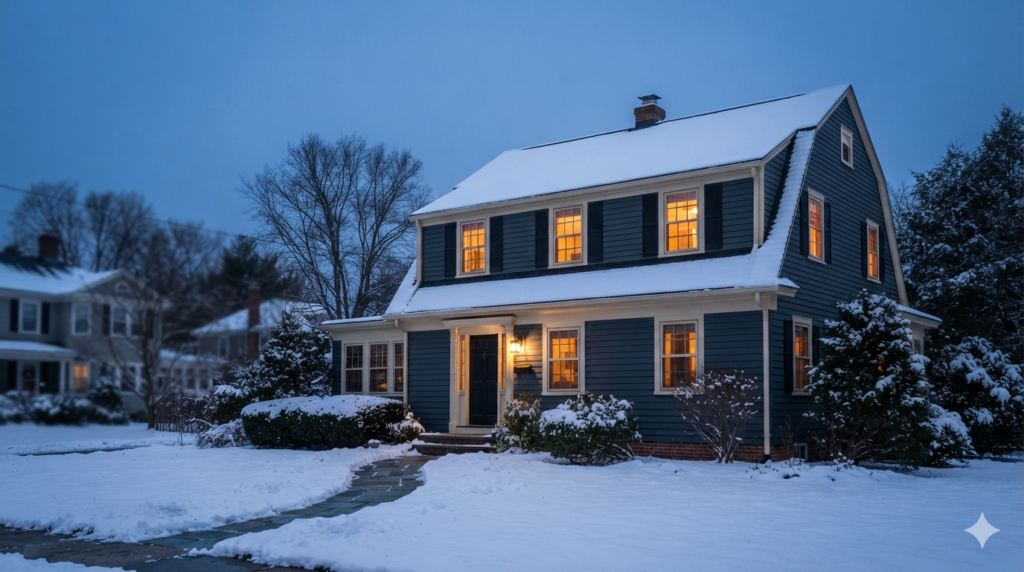
It’s a familiar winter routine in a lot of Capital Region homes. The living room feels fine, but climbing the stairs at bedtime feels like walking into a different season. If you’ve noticed your upstairs rooms colder in winter than the rest of the house, you’re not imagining it—and your furnace often isn’t the culprit. The real reason usually sits right above your head, in the attic and roof.
This guide explains what’s happening, how to spot the clues (some visible from your driveway), and which fixes matter most. It draws on years of residential roofing experience in the Capital Region, where long winters expose every weak spot between a home and its roof.
Quick Answer: Upstairs rooms are colder in winter mostly because heat escapes through the attic. Warm air rises and leaks through gaps in the ceiling, while thin or settled attic insulation lets heat pass straight to the roof. Leaky attic ductwork, exposed knee walls, and a thermostat located downstairs make it worse. Air sealing and insulation usually fix it.
Why Is Upstairs Colder Than Downstairs If Heat Rises?
Warm air really does rise. The problem is where it goes next. Cornell Cooperative Extension of Essex County explains that rising warm air gets pushed into the unheated attic through cracks and holes in the ceiling, while cold outdoor air is pulled in through gaps lower in the house. This is called the stack effect, and it means the heat meant for your bedrooms often leaks into the attic first.
What Makes Upstairs Rooms Colder in Winter
Most cold upstairs rooms come down to five causes, and many homes have more than one.
1. Air Leaks Into the Attic
The ceiling under your attic is full of hidden holes: recessed lights, the attic hatch, plumbing vents, wiring holes, and chimney chases. Each one lets warm air slip into the attic. According to Fine Homebuilding, air leaks can be responsible for a third or more of the energy loss in typical houses.
2. Thin or Settled Attic Insulation
Insulation slows heat moving from your rooms to the roof—if there’s enough of it. For the cold climate zones that cover upstate New York, ENERGY STAR recommends bringing an uninsulated attic up to R60, or adding R49 if you already have 3–4 inches. Settled or compressed insulation often falls well short.
One catch: Cornell Cooperative Extension notes that adding attic insulation does little unless air leaks are sealed first. Insulation slows heat, but it doesn’t stop moving air.
3. Knee Walls, Finished Attics, and Rooms Over the Garage
Cape Cods, finished attic bedrooms, and “bonus rooms” over garages are common across the Capital Region, and they’re often the coldest rooms in the house. They’re surrounded by unheated attic space, separated only by short knee walls and sloped ceilings. Building America notes that properly sealing and insulating knee walls can significantly reduce air leakage and heat loss. An upstate New York home-performance contractor writing in the Journal of Light Construction describes rooms over garages running about 20°F colder than the rest of the house.
4. Ductwork Running Through a Cold Attic
In many two-story homes, the ducts that feed upstairs rooms run through the attic. ENERGY STAR reports that in a typical house, about 20 to 30 percent of the air moving through the duct system is lost to leaks, holes, and poorly connected ducts. When those leaks are in a freezing attic, upstairs rooms get the weakest, coolest airflow in the house.
5. A Downstairs Thermostat and More Exposed Surfaces
Most thermostats sit on the first floor, so the heat shuts off once downstairs is comfortable—even if the bedrooms haven’t caught up. Upstairs rooms also have more exposure: a roof overhead and exterior walls on two or three sides.
Why Some Rooms Are Colder Than Others
If one or two rooms are always colder than the rest, their location usually points to the cause.
| Room | Most Likely Cause | First Thing to Check |
| Room over the garage | Leaky floor and knee walls over unheated space | Insulation and air sealing in the floor and knee walls |
| Finished attic or Cape Cod bedroom | Unsealed knee walls and thin sloped-ceiling insulation | Knee-wall doors, the attic spaces behind them, and the sloped ceiling |
| Corner bedroom | Two exterior walls plus roof exposure | Windows, outlets on exterior walls, attic insulation above |
| Room under a dormer or low-slope roof | Little space for insulation and limited ventilation | Insulation depth and ventilation in that roof section |
| Room farthest from the furnace | Long duct runs, often through the attic | Duct connections and insulation in the attic |
| Bedroom near the attic hatch | Leaky, uninsulated hatch or pull-down stairs | Weatherstripping and insulation on the hatch |
Your Roof Can Tell You What’s Happening in the Attic
After a snowfall, your roof works like a giant heat map.
- Uneven snowmelt. Bare patches over certain rooms mean heat is escaping. University of Minnesota Extension notes that heat flowing up from the house is what creates uneven roof temperatures.
- Ice dams and big icicles. ENERGY STAR lists a history of ice dams as an indication of serious air leaks.
- Frost or dampness under the roof deck. Green Building Advisor notes that air leaking into the attic can carry water vapor that condenses on cold surfaces, leading to rot and mold.
- Blocked soffit vents. Insulation stuffed into the eaves chokes off the airflow that keeps the attic cold and dry.
If you notice any of these, a professional roof inspection can confirm what’s going on, including ventilation, deck condition, and any moisture damage that needs roof repair.
How to Fix Cold Upstairs Rooms
Start With a Home Energy Assessment
Before paying for any single fix, find out where your house is actually losing heat. New York homeowners can work with a NYSERDA participating contractor to get a no-cost energy assessment, which typically includes testing that pinpoints air leaks. That report tells you which fixes will make the biggest difference for a cold upstairs.
Then Work From the Top Down
The most effective fixes usually follow this order.
| Fix | What It Solves | Who Usually Handles It |
| Air seal the attic floor | Warm air leaking into the attic | Insulation or energy-efficiency contractor |
| Add insulation to recommended levels | Heat moving through the ceiling | Insulation contractor |
| Seal and insulate knee walls and bonus rooms | Cold finished attics and rooms over garages | Insulation or energy-efficiency contractor |
| Seal and insulate attic ductwork | Weak, cool airflow upstairs | HVAC contractor |
| Balance attic ventilation | Moisture, frost, and ice dams | Roofing contractor |
| Balance, zone, or add a ductless mini-split | A room that stays cold after the attic is fixed | HVAC contractor |
What These Fixes Cost
National cost data puts attic insulation at about $2,100 on average, with most projects between $1,700 and $2,500, depending on attic size, insulation type, and whether old insulation must come out. Duct sealing averages about $2,250, with a typical range of $500 to $4,000. For a room that stays cold even after the attic is fixed, a ductless mini-split is a bigger investment—typically $2,500 to $15,000 or more depending on the system, with single-zone setups at the lower end.
New York homeowners may also qualify for help: through NYSERDA’s Comfort Home Program, incentives of $1,000 to $4,000 may be available for seal-and-insulate packages.
Where Your Roof Fits In
Insulation and air sealing keep heat in; ventilation keeps the attic cold and dry above it. ENERGY STAR explains that outside air should enter at the soffits and exit through gable or ridge vents, with rafter vents (also called baffles) keeping the soffits clear. Without that balance, frost, moisture, and ice dams can show up even after you’ve fixed a cold upstairs.
That’s why a roof replacement is one of the best moments to fix attic problems. With the roof open, a crew can check the deck and correct ventilation. Regular roof maintenance also catches blocked vents and moisture early.
What NOT to Do About Cold Upstairs Rooms
- Don’t pile on insulation before sealing air leaks. Air moves right through loose insulation.
- Don’t bury the soffit vents. ENERGY STAR is blunt: never cover attic soffit vents with insulation. Use baffles to keep airflow open.
- Don’t cover older recessed lights with insulation. ENERGY STAR advises keeping insulation at least 3 inches away from “can” lights unless they’re rated IC (insulated ceiling).
- Don’t vent bathroom fans into the attic. Building America guidance is to vent bath fans outdoors—not into an attic, crawlspace, or the space between floors.
- Don’t assume you need a bigger furnace. If heat leaks into the attic, a larger system just heats the attic faster.
- Don’t rely on space heaters long term. They treat the symptom and add fire risk.
Seasonal Timing: When to Tackle It
Winter is the best time to find the problem: watch your snowmelt, note which rooms feel coldest, and look for ice at the eaves. Late spring through early fall is the easiest time to fix it, when attics are comfortable to work in and roofs are dry. The payoff comes twice, since the same leaks that chill your bedrooms in January make them stuffy in July.
Warm Bedrooms Start at the Top of the House
A cold upstairs isn’t something you just have to live with. In most homes, it means warmth is escaping right where your house meets its roof. Seal the leaks, bring insulation up to recommended levels, give the attic the ventilation it needs, and make sure your ducts deliver what your furnace produces. Your upstairs can feel like part of the same house again—without cranking the thermostat.
About Star Roofing
At Star Roofing, we live and work in the same communities as you, so we know what a long Capital Region winter feels like from the top floor. We’re a second-generation, family-owned company founded in 1997, and our highly trained crews understand how our climate, our older homes, and our freeze-thaw cycles affect the roof and the attic beneath it.
If your snowmelt, ice dams, or attic tell you something isn’t right, we’ll take an honest look from the roof side and point you to the right next step—even when it isn’t a roofing job. We’re proud to serve homeowners and business owners across our Capital Region service areas.
Reach out to Star Roofing today for a free consultation and find out why so many local homeowners trust us to stand behind every roof we build. No pressure, no hard sell—just honest answers from people who care about getting it right.