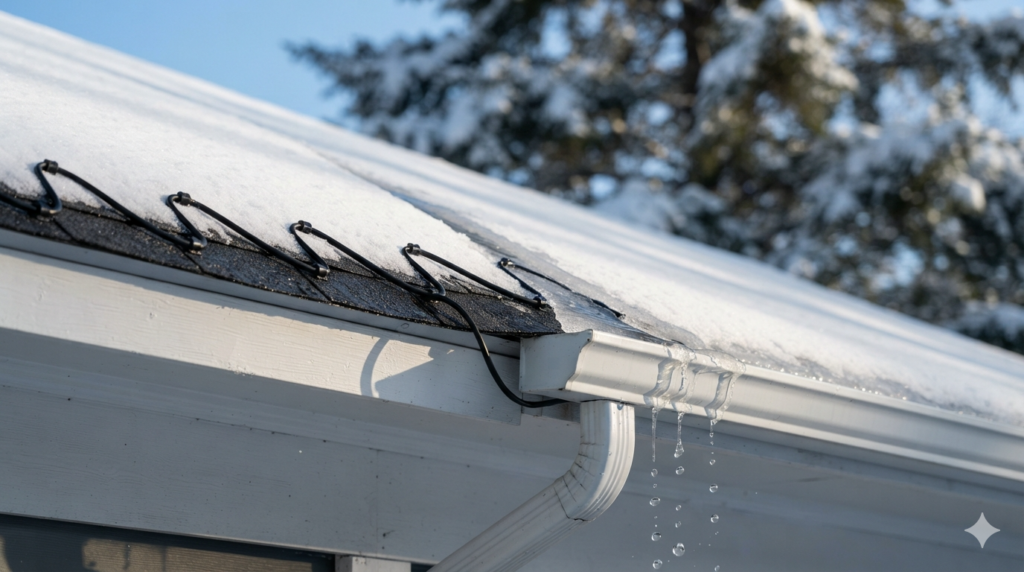
Every winter in the Capital Region, the same scene plays out. A few inches of snow, a sunny afternoon, a hard freeze overnight—and a ridge of ice forms along the gutters. That’s usually when homeowners start asking about heat cables on roofs, and whether those zig-zag wires along the eaves are the answer.
The honest answer is “sometimes.” Roof heat cables can be a smart tool in the right spot and an expensive frustration in the wrong one. This guide covers how they work, what they cost to install and run in New York, and how to tell which group your home is in. It’s grounded in years of residential and commercial roofing experience in the Capital Region, where freeze-thaw cycles test every roof from Albany to Saratoga.
Quick Answer: Yes—heat cables on roofs work, but not the way most people expect. They don’t stop ice dams from forming or clear snow off your roof. They melt narrow drainage channels through ice so water can escape instead of backing up under shingles. They’re worth it for chronic problem spots, not as a substitute for fixing attic heat loss.
What Are Heat Cables on Roofs?
Roof heat cables (also called heat tape, heat trace, or roof de-icing cables) are insulated electrical cables that warm up when powered. They’re clipped to the roof in a zig-zag pattern along the eaves, then run through the gutters and down the downspouts, so meltwater has a warm path all the way to the ground. They’re usually placed where ice builds up: eaves over unheated overhangs, roof valleys, and gutters that freeze solid.
Self-Regulating vs. Constant-Wattage Cable
| Feature | Self-Regulating Cable | Constant-Wattage Cable |
| Heat output | Adjusts with temperature | Same output whenever it’s on |
| Typical use | Professionally installed, hardwired systems | Plug-in kits from hardware stores |
| Energy use | Lower, especially with a sensor | Higher if left on all season |
| Overlap tolerance | Can usually touch or overlap itself | Can overheat if it touches itself |
| Upfront cost | Higher | Lower |
For reference, one manufacturer’s self-regulating roof and gutter cable has a nominal output of 5 watts per linear foot at 50°F. Paired with a temperature and moisture sensor, it runs only when there’s actually snow or ice to melt.
Why Ice Dams Form in the First Place
An ice dam isn’t really a roof-edge problem. It’s a heat problem that shows up at the roof edge. According to University of Minnesota Extension, ice dams are mainly caused by heat flowing up from the house, which leaves the roof surface at uneven temperatures. Warm air leaks into the attic and melts the bottom layer of snow. The meltwater runs down to the cold eave and refreezes, building a ridge that traps more water behind it until the water works its way under the shingles.
Capital Region winters are close to ideal for this: steady snow cover, frequent swings above and below freezing, and plenty of older homes whose attic insulation has settled over the decades. Once water gets inside, a simple winter annoyance can turn into a roof repair.
Do Roof Heat Cables Actually Work?
Yes, when they’re designed and installed correctly. It just helps to be clear about what “work” means.
Prevent or Manage?
Roof heat cables manage ice dams. They don’t prevent them. A cable melts a channel through the ice right around itself, which the manufacturer describes as creating a pathway for water to drain properly. Ice can still sit on the eaves in February. If water is draining and your ceilings stay dry, the system is doing its job.
Snow and Icicles
De-icing cable melts only a narrow strip, so it won’t clear snow off the roof. Icicles are a different story. Cable that runs through the gutters and down each downspout can cut icicles significantly. Roof-only installations often just move the refreeze point to the gutter lip.
How Long Do Heat Cables Last?
That depends on the product and how well it was installed. One manufacturer backs its self-regulating roof cable with a 10-year warranty, while its plug-in heat tape kits carry three years. The same manufacturer notes its self-regulating cable loses its power ramp-up ability at about 5–10 years but keeps working at its rated wattage after that.
What Heat Cables on Roofs Cost
National cost guides put roof heating cable at $5 to $15 per linear foot installed, or about $500 to $2,000 for a typical home. Another reports an average of $981, with most projects between $466 and $1,502. If your town requires a permit, budget roughly $250 to $900 for it.
The cost goes up with self-regulating cable, long eaves and multiple valleys, steep or multi-story roofs, new electrical circuits, and sensor controls. Roof condition matters too. If your roof is near the end of its life, paying for cable now and removing it for a roof replacement in a year or two rarely makes sense.
What They Cost to Run in New York
New York’s average residential electricity price was 28.65 cents per kWh in August 2026, the sixth-highest in the nation, according to an Empire Center analysis of U.S. Energy Information Administration data. Here’s a hypothetical example for 150 feet of cable at 5 watts per foot:
- 150 ft × 5 W = 750 watts, or about 21 cents per hour
- Left on 24/7 for a month: roughly $155
- On a sensor, assuming (for illustration only) about 300 hours of runtime over a winter: roughly $65 for the season
Real numbers vary with your utility rate and the weather, and self-regulating cable puts out more heat in colder conditions. The takeaway holds, though: controls matter more than cable price.
When Heat Cables on Roofs Are Worth It
Heat cables pay off when the root cause can’t practically be fixed, or when one stubborn spot keeps causing trouble. They’re a good fit when:
- One area keeps icing up. A valley over a porch, a low-slope section meeting a steeper one, or an eave above a cathedral ceiling.
- The attic can’t be fully fixed. Finished attics, knee walls, and cathedral ceilings in many older homes don’t leave room for modern insulation levels.
- You’ve already sealed and insulated. Cable is a reasonable backup for what’s left.
- The roof is in good shape. Cable belongs on a sound roof.
- It will be installed properly, with a dedicated circuit, the required ground-fault protection, and automatic controls.
Cables work on most roofing materials, including metal roofing, but metal roofs shed snow differently and need clips made for metal panels. That’s a good reason to have the layout designed rather than improvised.
When They’re Not the Right Fix
Heat cables are a workaround, not a cure, and some agencies are blunt about it. The Minnesota Department of Commerce tells homeowners not to install heating cables, warning that they shorten roof life and add to energy costs. NDSU Extension also notes that electric roof cables waste energy on top of the heat already escaping the house. The same building science applies to homes in upstate New York.
Cable probably isn’t your best first move if ice dams form across most of the roof, if your attic has never been checked, if the roof is aging or already leaking, or if you’d be relying on an extension cord. A professional roof inspection is often the fastest way to find out which side of the line you’re on.
Root-Cause Fixes That Work Alongside Heat Cables
The most lasting fix is keeping the roof deck cold and even. ENERGY STAR notes that air sealing combined with attic insulation can help prevent ice dams in winter. New York homeowners may also get help paying for it: NYSERDA’s Comfort Home Program offers tiered incentives on seal-and-insulate packages.
| Approach | What It Does | Cause or Symptom? |
| Attic air sealing | Stops warm air leaking into the attic | Cause |
| Attic insulation | Slows heat moving up to the roof deck | Cause |
| Balanced ventilation | Flushes leftover heat out of the attic | Cause (supporting) |
| Ice barrier underlayment | Protects the deck if water backs up | Damage protection |
| Roof raking | Removes snow from the eaves before it can refreeze | Symptom |
| Heat cables | Keeps drainage channels open through ice | Symptom |
Ice barrier underlayment deserves a special mention. The 2020 Residential Code of New York State is based on the 2018 International Residential Code, which requires an ice barrier in ice-dam-prone areas extending at least 24 inches inside the exterior wall line. It goes on under the shingles during a new roof installation, and it’s one of the best defenses against ice dam leaks.
What NOT to Do With Roof Heat Cables
- Don’t nail or staple cable through shingles. Use clips made for your roofing material.
- Don’t plug it into an extension cord. The National Electrical Code requires ground-fault protection of equipment for fixed outdoor deicing and snow-melting systems, including roof and gutter cable.
- Don’t let constant-wattage cable cross itself. It can overheat and burn out.
- Don’t stop at the gutter. Without heat in the gutters and downspouts, water simply refreezes one step lower.
- Don’t leave it on all winter. Without a sensor, you’re paying to heat the outdoors on dry days.
- Don’t chip ice around the cable, and please don’t climb an icy roof to adjust it. Winter roofs are among the most dangerous surfaces a homeowner can stand on.
Seasonal Timing: Fall, Winter, and Spring
Heat cables are a fall project. October and early November give crews dry, safe roofs for installation and testing. During winter, check from the ground after big storms that the controller is on and water is draining. In spring, look for clips knocked loose by sliding snow and for debris in the gutters. Fitting this into your regular roof maintenance keeps small issues from growing.
The Smartest Fix Starts With the Right Question
Heat cables aren’t good or bad on their own. The better question is why your roof is icing up. If it’s one stubborn valley or an eave over a cathedral ceiling, a well-installed, sensor-controlled cable can be a great investment. If it’s heat pouring into the attic, cable just pays to melt water that shouldn’t be there in the first place. Start with the cause, protect the roof deck, and use cable where it truly adds value.
About Star Roofing
At Star Roofing, we live and work in the same communities as you, so we know exactly what a Capital Region January does to a roofline. We’re a second-generation, family-owned company founded in 1997, and our highly trained crews understand how our winters, our older homes, and our freeze-thaw cycles affect a roof.
When you call us about ice dams, we won’t push you toward a product. We’ll help you find out what’s actually causing the problem and talk through your options honestly. We’re proud to serve homeowners and business owners across our Capital Region service areas.
Reach out to Star Roofing today for a free consultation and find out why so many local homeowners trust us to stand behind every roof we build. No pressure, no hard sell—just honest answers from people who care about getting it right.